"10x" is a number anyone can just type in
Every time someone shows me a 10x from vibe coding, I'm looking at a number someone typed, not a number anyone measured. That's the whole problem. Nobody hands you the 10x in a form you could check yourself. Push on it and it turns out to be lines of code, or how good the afternoon felt. That isn't a metric.
The measurements that exist don't show anything close to 10x. When METR ran a controlled trial on experienced open-source developers in early 2025, AI made them about 19% slower — while they expected, and still felt, a speed-up. A follow-up later that year points the other way: a modest speed-up. But the error bars cross zero, and METR says its own number is biased downward, because the developers who get the most from AI increasingly refuse to work without it — even for $50 an hour — so they drop out of the study. Put it together and the honest range runs from roughly a fifth slower to a fifth faster. Small, contested, and nowhere near an order of magnitude.
The one group that bothered to break the numbers down by kind of engineering gave the game away while doing it.
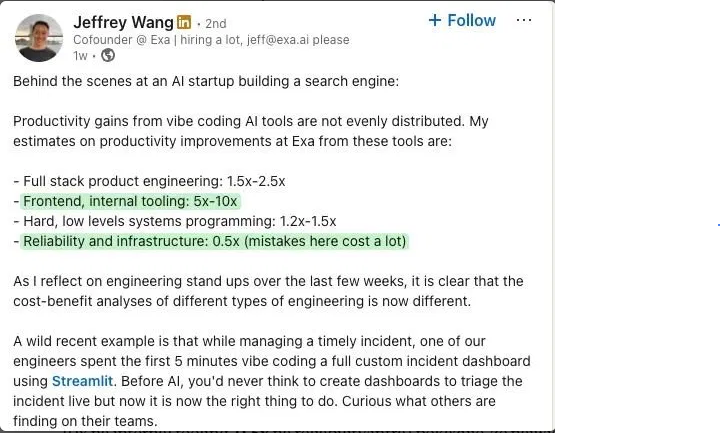
Jeffrey Wang, cofounder at Exa, estimating vibe-coding productivity gains by type of engineering.
His estimates: full-stack 1.2–2.5x, frontend and internal tooling 5–10x, hard low-level systems 1.2–1.5x. Reliability and infrastructure: 0.5x, because "mistakes here cost a lot."
Read it slowly. The biggest gain is exactly where the stakes are lowest. The only drop is exactly where they're highest. That isn't a pitch for vibe coding. It's a warning, and the person selling the upside wrote it himself.
And it does work. Vibe-coded software can be genuinely good — under three conditions the people quoting 10x tend to skip. It has to sit on infrastructure someone else already made reliable. It can't be too big. And whoever builds it has to be disciplined enough that scope creep and the token bill don't catch up. Three conditions, rarely all true at once.
The trouble shows up later, when the AI-built apps turn out to be hard to maintain without AI. Give it two years. Half the company runs on them, you can't switch them off, and the same model that gave you 10x on the frontend is the 0.5x quietly eroding the parts that have to hold. You didn't buy productivity. You took on a dependency, and you pay it down in tokens.
The payment isn't fixed either. Today's token prices look subsidised — set to win market share, not to cover the cost of the business. That's the same reason the SaaS backbone stays expensive while the value layer gets cheap: the hard, reliable part is where the rent eventually lives. Once half your company runs on software you can't maintain without the model, you're not the one setting the rate. The vendor who knows you can't leave is. Lock-in pricing only moves one way.
So there's your 10x. The frontend gain is real. So is the 0.5x on the foundation, and the bill that arrives when you can't walk away.
If you're being shown 10x numbers and trying to work out which ones are real, that's the conversation. Reach out — happy to look at where AI is actually paying off in your stack and where it's quietly building a dependency.