Barbell
There's a Taleb idea about barbells — pair the extreme-safe end with the extreme-risky end, ignore the middle. I'm not borrowing the financial logic, just the shape, because the way AI adoption plays out lately, it kind of fits.
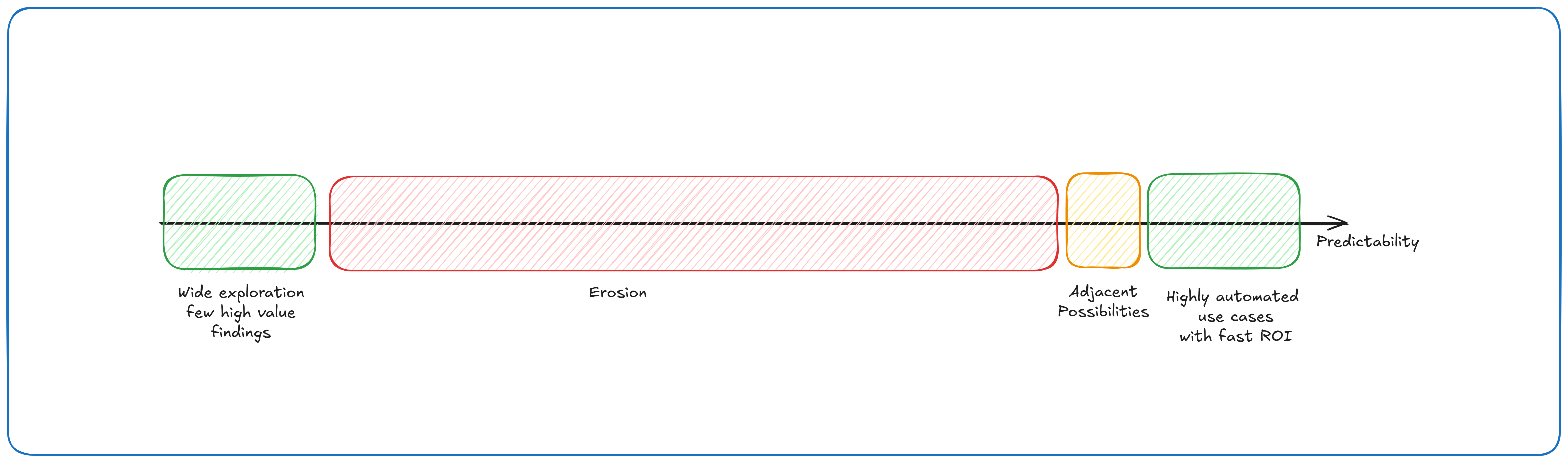
Same shape, mapped on a predictability axis: broad exploration at the low-predictability end, highly automated work at the high end, and a long erosion zone in between.
The way I think about it is predictability. Deterministic, well-scoped work — a code change reviewed before merge, a contract clause flagged for legal — automates cleanly. You know what good output looks like, and a human is there to catch the model if it's wrong. People like working this way and the ROI shows up pretty fast.
At the other end, wide, throwaway exploration. Brainstorming, or scanning a corpus for things you'd have missed. The model is probabilistic, most of what comes back is noise, and that's fine — the surface is wide and the human filters. The few keepers pay for the noise.
What's awkward is the middle. Same probabilistic engine, but now it's producing single, narrow outputs that someone's going to act on. Customer comms going out with light review. Recommendations that quietly become The Recommendation because nobody re-derives them. Most of the time the model is right. The times it isn't, the output still moves, and the gap is hard to see because the surrounding workflow looks structured. The erosion of judgement sits in here too, quietly.
Executives generally see all three. They see the wins at the controlled end and the value of the exploratory edge when their teams know what they're doing. They also see the mess in the middle. What I notice is that the mess usually gets read as "AI's still maturing" or "wrong vendor" — when really it's structural: a probabilistic engine running on narrow consequential output, with no wide filter to absorb the failures.
Vendors know the middle is where the money is and they're racing to structure it — guardrails, evals, governance layers. The thin band right next to the controlled end will probably get there, cases predictable enough that some structure can plausibly catch the failures. Most of the middle won't, at least not soon. Right now most of what's on offer is confident packaging on top of the same probabilistic engine, and treating "the vendor will sort it" as a plan is itself a middle-of-the-barbell move.
That's about it really. Tight governance at one end, exploration loose at the other. The middle is an open problem and probably not the next thing to buy.
If your AI adoption is doing well at the edges and getting tangled in the middle, that's the conversation. Reach out — happy to do a diagnostic on where things actually sit and what's worth changing.